
What to Do When Your HVAC Suddenly Stops Working
It is one of the most stressful moments for a homeowner. That moment of silence when you realize the familiar, low hum of your air conditioner has stopped on a blazing Orem summer afternoon. Or, even worse, you wake up on a frigid January morning to a freezing house, the furnace completely unresponsive. Your heating, ventilation, and air conditioning system is the heart of your home’s comfort. When it suddenly quits, it is not just an inconvenience; in the extremes of a Utah climate, it feels like a true emergency.
The first instinct is often panic, followed by the immediate fear of a massive repair bill. While many HVAC failures are serious and require a professional, a surprising number of service calls are for issues that the homeowner could have fixed themselves in minutes. Before you make that call, there are several key things you can check. A methodical, five minute investigation can sometimes save you the cost of a service visit or, at the very least, provide valuable information for the technician when they arrive.
First Steps: Check the Simple Things
The brain of your entire HVAC system is the thermostat on your wall. It is also the most common source of a “broken” system. A simple oversight here can make it seem like your entire furnace or air conditioner has failed. Start your investigation right at this control panel. If your system is off, the first step is to check its settings. If it is winter, is the thermostat set to “Heat”? If it is summer, is it set to “Cool”? This may seem obvious, but it is a frequent mistake, especially after a mild day when the system was turned off completely.

Next, look at the temperature setting. Is the setpoint actually calling for heat or cooling? If your thermostat is set to 70 degrees in the winter but the house is already 71, the furnace will not run, and that is normal. Try raising the setpoint several degrees above the current room temperature and wait a minute or two. For cooling, lower it several degrees below the room temperature. If the screen is completely blank, the thermostat has likely lost power. This could be from dead batteries, which are a simple replacement, or it could be related to a power issue from the HVAC unit itself.
If you have a programmable or smart thermostat, the schedule could be the issue. It is possible a “hold” or “vacation” mode was accidentally activated, or the schedule itself is programmed to be off at that time. For smart thermostats connected to Wi-Fi, a lost internet connection can sometimes disrupt its function, though most are designed to work without it. Always check the thermostat’s settings, batteries, and basic programming before moving on.
Investigate Your Home’s Electrical Panel
Your HVAC system is a powerful piece of equipment. The indoor furnace or air handler and the outdoor condenser unit both pull a significant amount of electricity. To protect your home’s wiring, these systems are connected to their own dedicated circuit breakers in your main electrical panel. This panel is usually in a utility closet, garage, or basement. When you open the metal door, you will see rows of breakers.
Need furnace maintenance? Click here for our furnace maintenance service.
A “tripped” breaker is a safety device that has cut power to a circuit because it detected an overload or a short. A tripped breaker will be in the “off” position or, more commonly, stuck in a middle position between “on” and “off.” Look for the breakers labeled “Furnace,” “Air Handler,” “AC,” or “Condenser.” You will often have two: one for the indoor unit and one for the outdoor unit.
If you find a tripped breaker, you can try to reset it. To do this properly, you must first push the breaker handle firmly to the “off” position, and then push it back to the “on” position. If it stays on, go check your HVAC system. It may have been a one time surge that caused the problem. However, if the breaker trips again immediately, this is a clear sign of a serious electrical problem. Do not try to reset it again. A breaker that repeatedly trips is a fire hazard, indicating a short circuit or a failing component that needs immediate professional diagnosis.
Check Your System’s Power Switches
Many homeowners are not aware that their HVAC system has multiple power switches, much like a light switch. The most common one is located on or very near the indoor furnace or air handler. It is often a standard light switch in a gray box, and its purpose is to allow service technicians to safely turn off all power to the unit while they are working on it. Because it looks just like a light switch, it is very common for it to be accidentally flipped off. Someone moving boxes in an attic or utility closet might bump it without realizing.
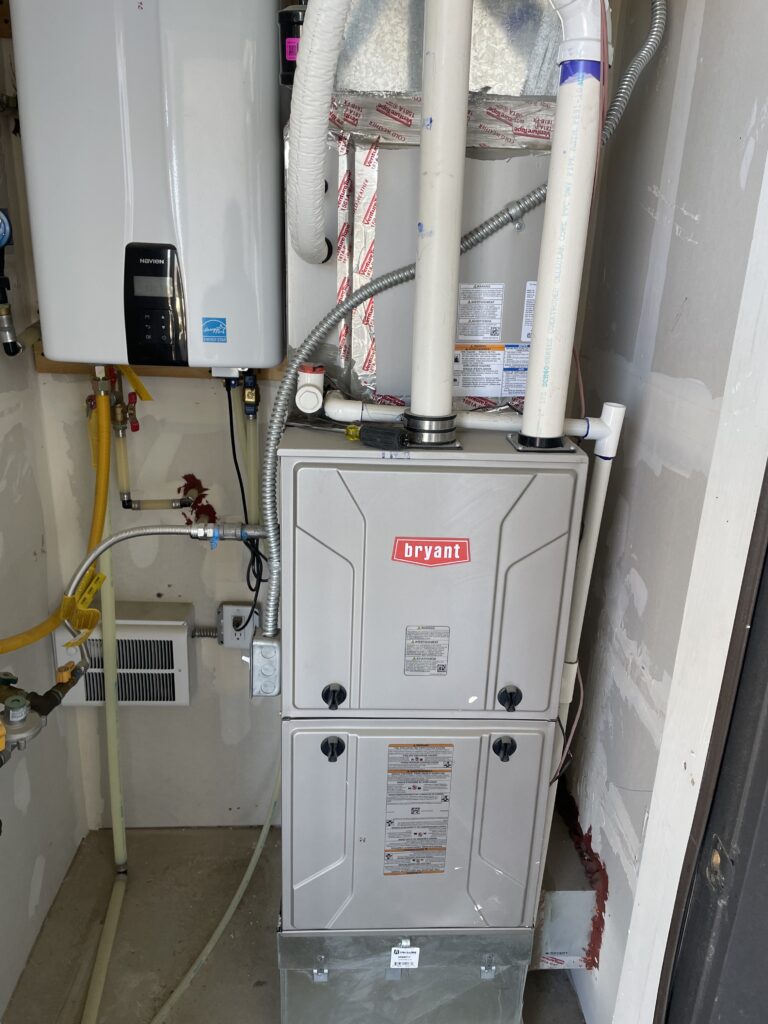
Go to your indoor unit and look for this switch. If it is in the “off” position, flip it back on and wait a few minutes. This may be all it takes to restore power to your thermostat and bring the system back to life.
There is also a power disconnect switch for the outdoor unit. This is usually a metal box mounted on the side of your house near the condenser. It will have a pull out tab or a lever. This switch is less likely to be accidentally turned off, but it is part of the system’s power chain. If this disconnect is pulled, the outdoor unit will not run, even if the indoor fan does. This is a less common problem, but good to be aware of.
The Most Common Culprit: Your Air Filter
The single most common cause of an HVAC system shutting down is also the easiest to prevent: a severely clogged air filter. The filter’s primary job is to protect the sensitive internal components of your system from dust, debris, and pet hair. When you neglect to change it, this buildup of dirt begins to starve your system of air. This lack of airflow is a critical problem.
In a furnace, the heat exchanger gets extremely hot. It relies on a constant stream of air from the blower motor to transfer that heat into your home. If the airflow is blocked by a dirty filter, that heat gets trapped. The furnace will overheat, and a safety device called the high limit switch will trip, shutting the entire system down to prevent a fire or a cracked heat exchanger. The furnace will not turn back on until it has cooled and the problem is fixed.
Want to prevent furnace issues? Click here for more information.
In an air conditioner, the system works by absorbing heat from your home’s air and releasing it outside. The indoor evaporator coil gets very cold. When airflow across that coil is restricted, the condensation on the coil does not get blown off. Instead, it freezes. This ice will continue to build until the entire coil is a solid block, stopping all airflow and all cooling. You may notice the indoor unit is running but no air is coming from your vents. If you look inside, you will likely see ice. To fix this, you must turn the AC system completely off at the thermostat and let it thaw for several hours before changing the filter and turning it back on.
Inspect Vents and Outdoor Equipment
Airflow is a two way street. Your system needs to be able to pull air in and push air out. Check all the “return” air grilles in your home. These are the larger vents that suck air back to the system. They should never be blocked by furniture, rugs, or boxes. A blocked return is just like a clogged filter; it chokes the system and can lead to overheating or freezing.
Also, check your supply vents, the ones that blow air out. Make sure most of them are open. Closing too many vents in unused rooms can create too much back pressure in your ductwork, which also strains the system and can cause it to shut down.

Finally, go outside and look at your equipment. In Orem, winter storms can pile snow up against your home. If you have a high efficiency furnace, it will have two PVC pipes coming out the side of your house for intake and exhaust. If these pipes are blocked by a snow drift or ice, the furnace’s safety sensors will shut it down to prevent dangerous gases from backing up into your home. You must keep these vents clear.
For a heat pump or air conditioner, the outdoor condenser unit needs to be clear. In winter, snow can bury a heat pump, stopping it from working. In summer, cotton from Orem’s many cottonwood trees can plaster the condenser fins, acting like a blanket and preventing the unit from releasing heat. Gently hose off any dirt or debris.
When to Stop and Call a Professional
If you have gone through all these steps and your system is still not working, the problem is internal and requires a professional. It is crucial to know your limits. Modern HVAC systems are complex, and attempting a do it yourself repair on internal parts can be dangerous and will void your warranty.
It is time to call Vortex Air HVAC immediately if you notice any of the following: The circuit breaker trips a second time after you reset it. You smell burning plastic or a “hot” electrical odor, which could mean a motor is burning out. You hear loud, mechanical noises like grinding, squealing, or banging. These are signs of a severe mechanical failure.
The most serious warning sign is the smell of natural gas, which smells like rotten eggs or sulfur. If you smell this, do not do anything else. Do not flip any switches or use your phone. Leave your home immediately, and from a safe distance, call 911 or your utility’s emergency line. Once the gas is shut off, Vortex Air HVAC can be called to repair the gas line.
A non functional HVAC system is a major disruption, but it does not always mean a major repair. By calmly checking the thermostat, circuit breaker, power switches, and air filter, you can often identify and solve the problem yourself. These simple checks can restore your comfort and save you money. However, a key part of this process is recognizing when the problem is beyond a simple fix. Your safety is the top priority. If the basic troubleshooting steps do not work, or if you see any signs of a serious electrical or mechanical problem, it is time to call in the experts. For any HVAC problem big or small, the team at Vortex Air HVAC is ready to help Orem residents get their systems back up and running safely and efficiently.